
Public Service Spaces
Serving Every Community.
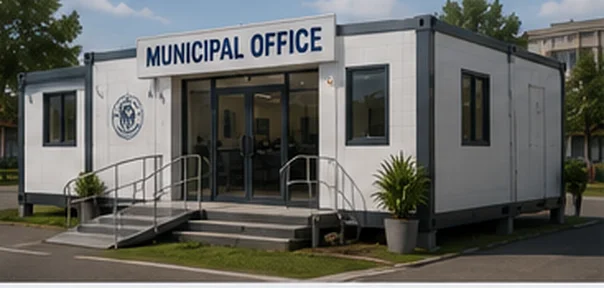
Modular buildings can be adapted for community service centers, administrative offices, public safety facilities, information points and other government applications. Standardized construction and flexible configurations support efficient delivery across urban, rural and temporary project locations.
A Unit Mix That
Fits the Scenario
| Scenario | Recommended Model | Why |
|---|---|---|
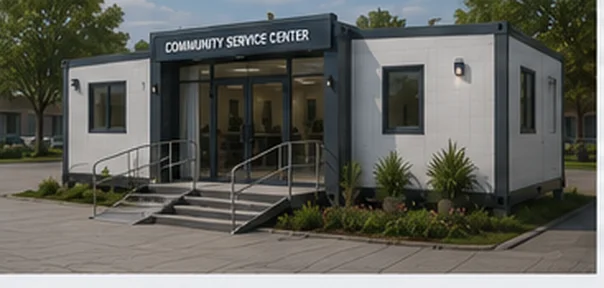
| Community service centers | 20ft / 30ft Expandable | Waiting, interview and office zones arranged under one roof |
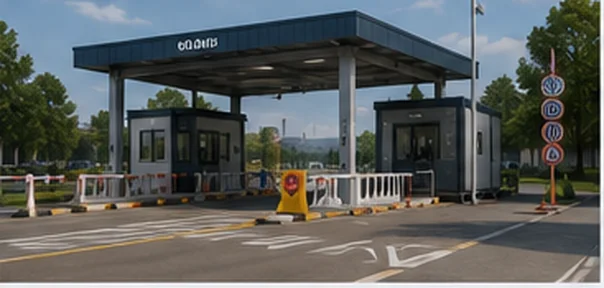
| Checkpoint & guard posts | 10ft Expandable — guard-room layout | Compact booth footprint; 4 units per 40HQ for distributed posts |
| Mobile administration units | Rapid Z-Fold · Compact Mid-Fold | Fold-flat transport and hours-fast opening for rotating or temporary sites |
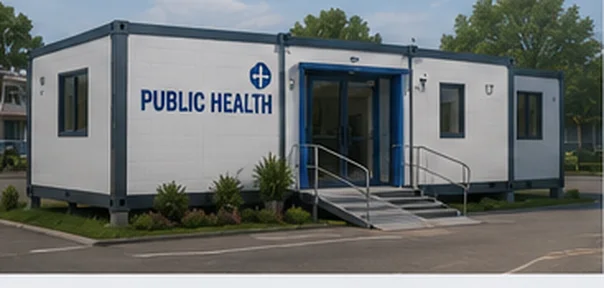
| Public health & amenity units | 20ft Expandable · Modular Bathroom Pod | Consultation space paired with hygienic, factory-finished wet modules |
- Tender-ready standardization — consistent specifications across production batches simplify tendering, inspection and multi-site rollouts.
- Engineered for public durability — hot-dip galvanized steel frames and insulated sandwich panels, with wind resistance up to Grade 11 (280 km/h) on expandable models.
- Rapid civic deployment — units unfold and connect in hours, keeping community services online during construction works, emergencies and peak seasons.
- Flexible civic layouts — service halls, offices, interview rooms and health units arranged to match each department's workflow.
- Relocatable public assets — standardized units move between urban, rural and temporary sites, protecting budget across project cycles.
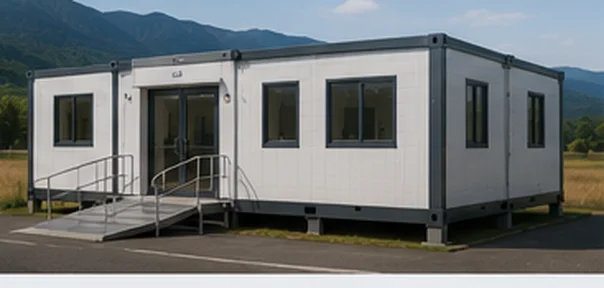
Concept layouts rendered from the standard unit system — configuration, finishes and scale vary per project.
Engineered for Local Standards
Electrical packages can be specified to EU, US, UK and AU site requirements, built around CE-certified components, with insulation upgrades from the standard 75 mm EPS sandwich panels to rock wool or PU cores for all-climate operation. Units are supplied with specification sheets, packing data and component certificates — including WaterMark-listed fixtures and valves for Australian projects — to support tender submission and local approval processes. Official signage, insignia and emblems are applied by the responsible authority after delivery, keeping buildings neutral at the factory gate.
Common
Questions.
Do you support tender and procurement documentation?
Yes — every program is supplied with specification sheets, packing data and component certificates. Additional documentation required by your tender is confirmed at order stage.
Can buildings carry official signage and emblems?
Units ship in neutral finishes so that official signage, insignia and emblems are applied locally by the responsible authority, in line with its own regulations.
Can units serve multiple sites over time?
Yes — standardized units are designed to be lifted and re-sited between urban, rural and temporary locations. Confirm the handling method for your model with our team at order stage.
How durable are the buildings?
Hot-dip galvanized steel frames with insulated sandwich panel walls as standard; expandable models are engineered for wind resistance up to Grade 11 (280 km/h). Full specification sheets are available on request.
Start Your
Tender Package.*
Send quantities, destination ports and submission deadlines — we will prepare specifications, documentation and a production schedule to match.