
TL;DR: Your ADU Build Cost at a Glance
An ADU build cost breaks into four lines: hard costs (the unit, delivery, foundation, utility connections), soft costs (design, permits, review), site work, and a contingency you actually hold. Published US market ranges run from $25,000 to $250,000 for a full project, with factory-built prefab modules around $150 to $300 per square foot (Bob Vila). Prefab helps most with predictability and schedule, which trims the financing and vacancy drag that sit on the lines nobody prices up front. Every line item below carries a market reference, so you can pressure-test quotes before you commit.
What an ADU Build Cost Really Includes
An accessory dwelling unit (ADU) is a self-contained home on the same lot as a primary residence, with its own kitchen, bathroom, and entrance. NYC HPD uses that definition for its ADU work, and the city’s PlusOne program has closed, but the definition holds as a baseline most US jurisdictions share. Owners build ADUs for rental income, multigenerational living, or resale value, and developers increasingly treat them as a repeatable product line.
Budget conversations go off the rails when “ADU cost” means only the price of the unit. A full ADU build cost carries four lines, and three of them sit outside the factory or the contractor’s frame estimate:
- Hard costs: the unit or on-site construction, delivery and setting, foundation, and utility connections.
- Soft costs: design, engineering, permits, plan review, and any third-party inspections.
- Site work: grading, access, trenching, and whatever the lot needs before the unit lands.
- Contingency: a reserve you size with your builder and defend during value engineering.
If you are still deciding between unit types and approval routes, the companion piece on prefab ADU sizes and approval basics covers that decision before this one.
Hard Costs Line by Line
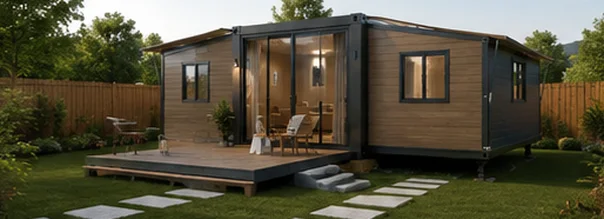
Hard costs are the lines with hardware attached. Published US references put a full container or prefab-style project between $25,000 and $250,000, with a single-container unit listing from $25,000 to $80,000 and prefab construction around $150 to $300 per square foot, according to Bob Vila’s cost analysis. Treat those figures as brackets for the unit itself, not as a turnkey total.
For readers comparing across formats, our container home cost benchmarks article works through the same bracket math for container-based units.
| Line item | What it covers | Market reference |
|---|---|---|
| Unit / construction | Factory module, kit, or on-site construction with standard finishes | $25,000 to $250,000 full project; $150 to $300 per sqft prefab (Bob Vila) |
| Delivery and setting | Transport, crane or tilt-bed, placement and anchoring | Quote-based; driven by distance and site access |
| Foundation | Slab, piers, or perimeter system under the unit | Quote-based; driven by soil and engineering |
| Utility connections | Power, water, sewer or septic, and gas if specified | Quote-based; typically the widest swing between sites |
Two habits keep this table honest. Get every hard line as a separate number, because bundled quotes hide where the money goes. Match each quote line to a drawing or scope note, so a change order has something to be measured against.
Soft Costs and Approvals
Soft costs buy permission and paper: surveys, architectural drawings, structural engineering, energy documentation, plan review fees, and impact or utility fees where the city charges them. They arrive early in the schedule, and they scale with how much discretion your jurisdiction keeps over ADU applications.
Discretion is the variable to watch. In California, state law requires ADU applications to be handled ministerially: staff check a fixed checklist, with no hearing and no judgment call, under the California Government Code. A ministerial track leaves the fees in place. It mainly narrows the uncertainty band around time and revisions, which is where soft-cost overruns come from.
Ask your designer or permit expediter for three numbers before drawings start: the fee schedule total, the expected review cycles, and the items reviewers typically flag. Those three answers turn the vaguest line in an ADU construction budget into something you can schedule around.
Site and Utility Line Items That Sink Budgets
Site work is where clean budgets most often break. None of it appears in a unit price list, and most of it stays invisible until a surveyor and a utility locate report touch the lot.
- Grading and access: slope, drainage, and a clear path for a crane or tilt-bed to the placement point.
- Foundation: engineered to your soil report, which can move the number more than any finish upgrade.
- Sewer or septic: distance to the main or the tank drives trenching length and pump decisions.
- Power and water: service upgrades or a new sub-panel, plus a water line and often a separate meter.
- Gas and data: optional lines that get cheaper to add while the ground is already open.
The pattern repeats across markets: the further the unit sits from existing utilities, the more the site and utility lines grow relative to the unit itself. On a tight urban lot with mains at the property line, these lines can be modest. On a rural or sloped lot with a septic system, they can rival the factory price of the unit. Get the survey and utility locates done before you sign a unit contract, because the results re-price everything above.
Where Prefab Changes the Math
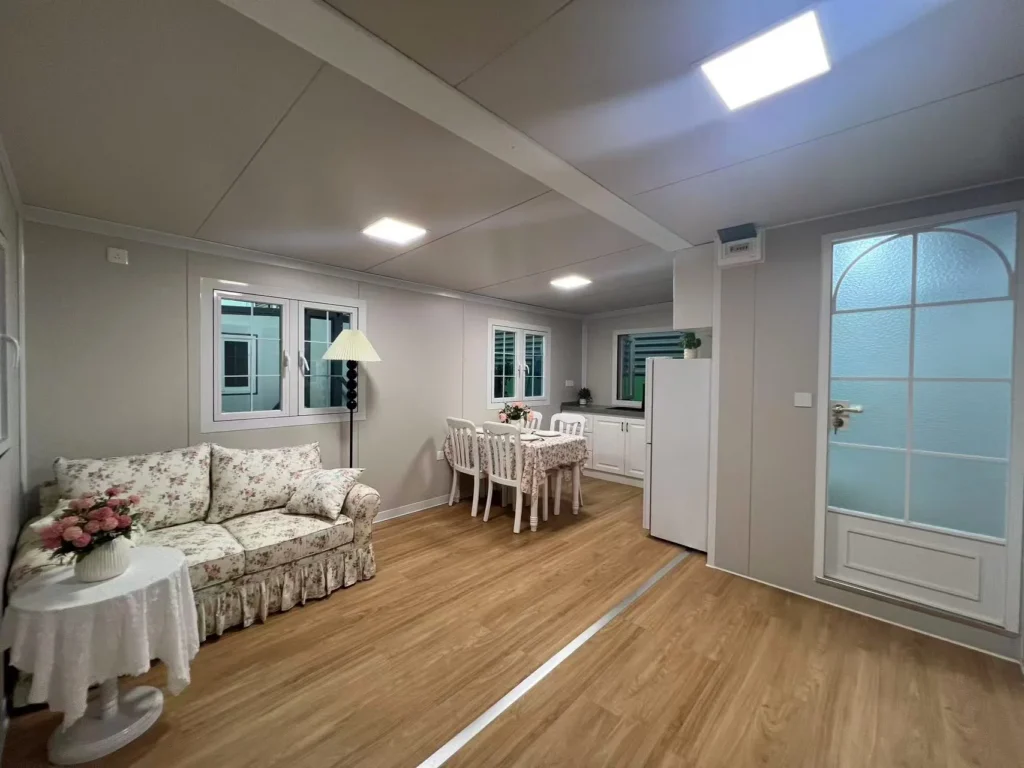
Prefab keeps the four-line structure. What changes is where the work happens: factory assembly replaces weather-exposed on-site sequencing, and the schedule compresses around it.
The Modular Building Institute reports that factory construction runs 30 to 50 percent faster than site building because foundation work and module fabrication proceed in parallel. A shorter schedule cuts the carrying costs that sit outside any unit quote: construction-loan interest, insurance months, and the vacancy window before rent starts.
Cost predictability is the second lever. The Modular Building Institute points out that modular pricing holds up better because most of the scope is fixed in a factory contract before site work begins, leaving fewer open-ended items to drift. Materials still matter for steel-framed units: the BLS producer price index for steel mill products climbed from 331.4 in March 2026 to 374.2 in July 2026, so it is fair to ask a supplier how their quotes handle steel movement between signing and production.
| Factor | Site-built | Prefab kit | Factory module |
|---|---|---|---|
| Cost predictability | Scope opens on site; change orders common | Unit price fixed; site scope open | Most scope fixed in the factory contract |
| Schedule | Sequential; weather-dependent | Partial overlap of trades | 30 to 50 percent faster reported (MBI) |
| On-site labor | Highest | Moderate | Lowest; mostly setting and connections |
| Where the risk sits | Contractor management | Your coordination of kit and trades | Delivery logistics and foundation readiness |
SunModu builds factory-finished expandable and folding container units for exactly this trade: the unit arrives complete, and the budget conversation moves to the site lines where it belongs. Buyers sourcing at program volume can review the Wholesale ADU & Granny Flats route, which is set up for multi-unit buyers instead of single-lot orders.
Budget Example: A Mid-Range Project
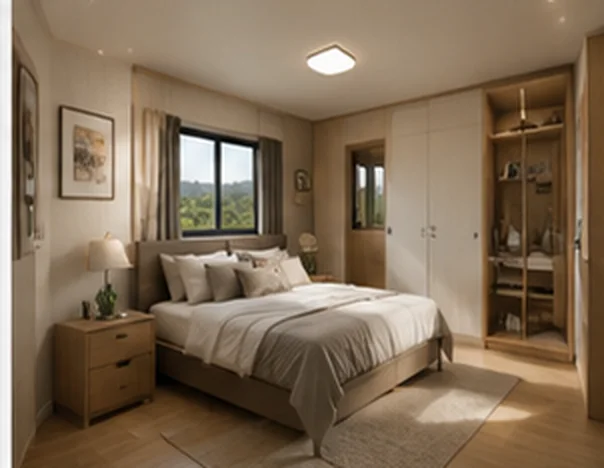
The table below assembles a paper budget for a 640-square-foot factory-built module, using the published prefab range of $150 to $300 per square foot (Bob Vila) as the only priced anchor. It is an example based on published market ranges, not a quotation. The quote-based rows are where your local numbers land.
| Line | Basis | Example entry |
|---|---|---|
| Factory-built unit | 640 sqft at $150 to $300 per sqft (Bob Vila) | $96,000 to $192,000 |
| Delivery and setting | Distance, crane access, anchoring | Quote-based |
| Foundation | Soil report and engineered drawings | Quote-based |
| Utility connections | Sewer or septic, power, water, gas | Quote-based |
| Soft costs | Design, permits, review, fees | Quote-based |
| Site work | Grading, trenching, access | Quote-based |
| Contingency | Sized with your builder | Held, not spent |
| Full-project bracket | Published US market range | $25,000 to $250,000 (Bob Vila) |
Use the example as a template for your quote requests. Ask every bidder to price the same rows in the same order. Your ADU build cost comparison then reads line for line, and a low bid has to explain itself wherever it runs thin.
Frequently Asked Questions
What is the cheapest way to build an ADU?
Published ranges show small single-container units starting at $25,000 to $80,000 (Bob Vila), which makes a compact factory unit the lowest published entry point. The cheapest route on paper often costs more once site work is priced, so keep the four-line structure and let the site report decide. Collecting several line-item quotes is dependable cost control in any market.
How much does site work add to an ADU build cost?
There is no flat number, because site lines are priced from the survey and utility locates, not from the unit. Distance to sewer, power, and water, plus slope and access, set the swing. Price the site report before the unit contract, and the ADU build cost stays a schedule of numbers instead of a running surprise.
Do ADU costs include permits?
Unit prices do not. Permits, plan review, and impact or utility fees sit in the soft-cost line, and the jurisdiction sets them. Ask for the fee schedule in writing before drawings start, so the soft-cost row reflects your city.
Is prefab cheaper than building an ADU on site?
Per published brackets, prefab construction lists around $150 to $300 per square foot (Bob Vila), and those numbers overlap site-built ranges. The prefab advantage shows up in schedule and predictability: a 30 to 50 percent shorter timeline reported by the Modular Building Institute lowers the interest and vacancy costs attached to the build. Price both routes on the same four lines before you decide.
A line-item budget is the difference between ordering a unit and finishing a project. When you are ready to price the factory side of the cost to build an ADU, SunModu quotes hard lines separately, and you can request a quote with your site details attached.